Redesigning the onboarding experience for trust and efficiency
The UX Operations Group North Star was to scale and streamline Design & Research processes, foster collaboration, and empower UXers to create impactful and innovative experiences.
THE SCOPE
THE SCOPE
How we cut onboarding time by 60%, increased completion by 16%, and shifted Uphold from a compliance-first to a user-first sign-up strategy, all while meeting strict KYC/AML regulations.
As UX Ops Manager I led the UX and Design Ops Vision & Strategy, fostering the growth of the Design Ops practice for a 70+ person design and research team. Within the UX Ops group, I was also overseeing the Design System and Research Ops teams.
- 60%
ONBOARDING TIME
+ 16%
COMPLETION RATE
-23%
IDV DROP-OFF
+17 pts
PERCEIVED TRUST SCORE

CONTEXT
A 10M-user crypto platform
losing people before they ever trade
Uphold is a global multi-asset trading platform supporting 360+ cryptocurrencies, 27 national currencies, and 4 precious metals. Despite its scale, the US onboarding funnel was haemorrhaging users, only 42% completed sign-up, and just 28% made their first deposit. The culprit: an 11-step flow that felt less like opening an account and more like a compliance audit.
The primary challenge was transforming a UX group rooted in engineering principles into a design team fully immersed in user experience. Additionally, my mission included enhancing overall processes and practices, elevating the maturity of this 70+ person design and research team to the next level.
My leadership challenge at OutSystems, particularly within the UX Ops group, was characterized by transformation, resilience, and a commitment to growth and excellence. Upon returning from maternity leave, I embarked on a journey to not only lead but also significantly develop the UX Ops area. This endeavor involved overseeing two teams, nurturing the growth of design leaders, and promoting a culture of collaboration and innovation. This team was quite eclectic, featuring eight designers with a variety of specialties such as interaction design, UX design, content design, research, and engineering.
CHALLENGE
Users were willing to comply.
They weren't willing to wait.
Research revealed a critical tension: users understood they needed to provide personal data for a regulated financial product, but their expectations were anchored in low-friction, high-trust experiences from modern fintech apps, a bar Uphold wasn't meeting.
BASELINE · ONBOARDING COMPLETION
42%
More than half of users abandoned before completing registration
BASELINE · IDV DROPF-OFF RATE
35%
Identity verification was the single biggest exit point — with retries and long processing delays
"It took too long. Other apps let me start right away."
- US user, usability research
RESEARCH & STRATEGY
Grounded in data,
structured in two parallel tracks
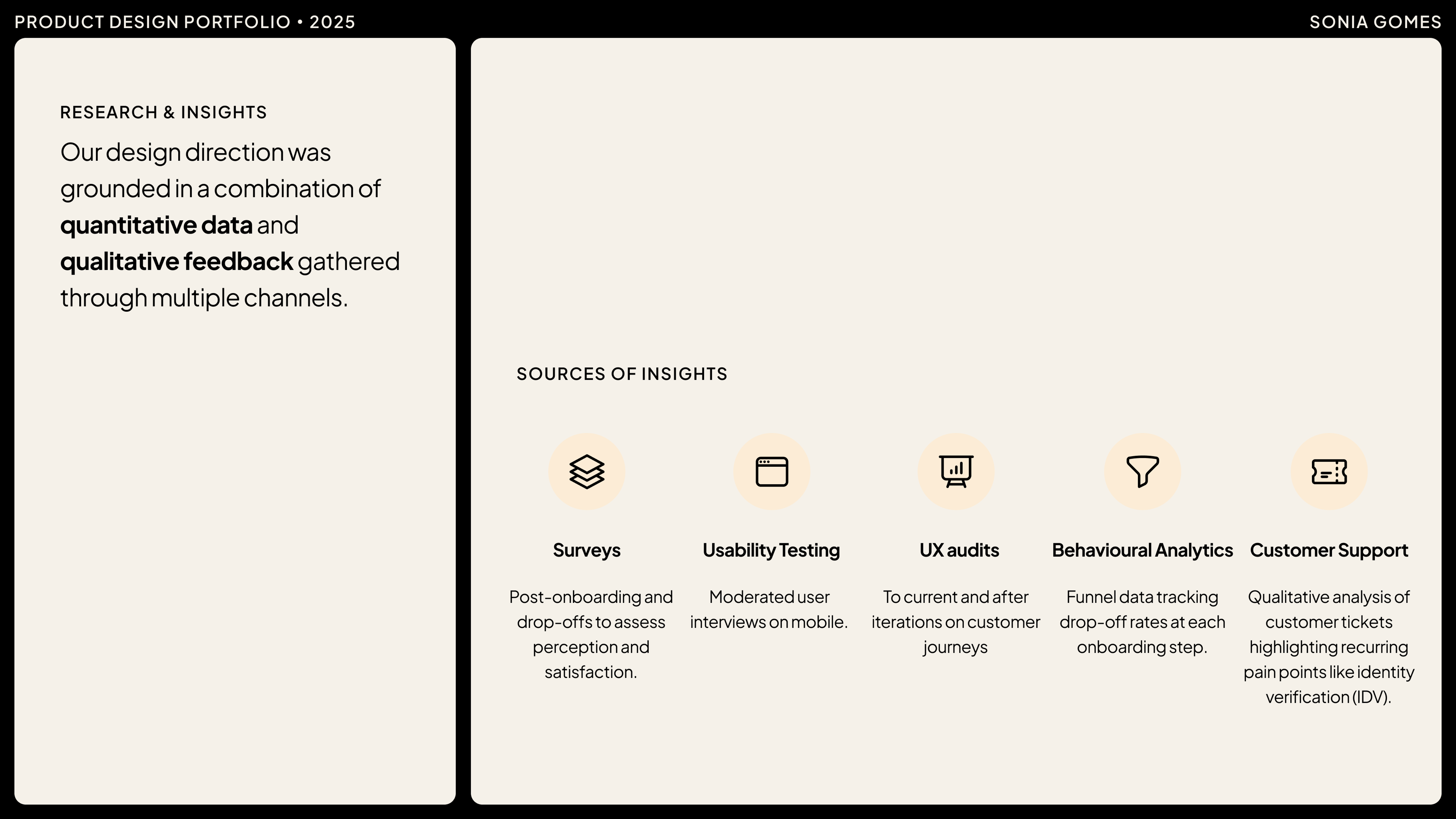
I led end-to-end design across the full 6-month project, combining quantitative funnel analysis with qualitative usability research. The work was structured into two coordinated tracks with shared user journeys but distinct success metrics.
TRACK 01
Onboarding
Simplify and clarify account creation. Reduce manual steps, eliminate friction at the entry point, and get users to value faster.
TRACK 02
Activation
Enable frictionless first deposit and build early trust. Turn registered users into active, engaged traders.
CONSTRAINT
Regulated by design
Every decision had to clear strict KYC/AML compliance with third-party dependencies, Veriff, Plaid, and Prove. Compliance was a collaborator, not a blocker.
DESIGN PROCESS · THE REAL STORY
We shipped, learned we were
solving the wrong problem, and pivoted.
This case study is honest about failure. The first solution looked right on paper and fell apart in the real world. Here's how the thinking evolved.
PHASE 1
Hypothesis: use Plaid to pre-fill data and link bank accounts
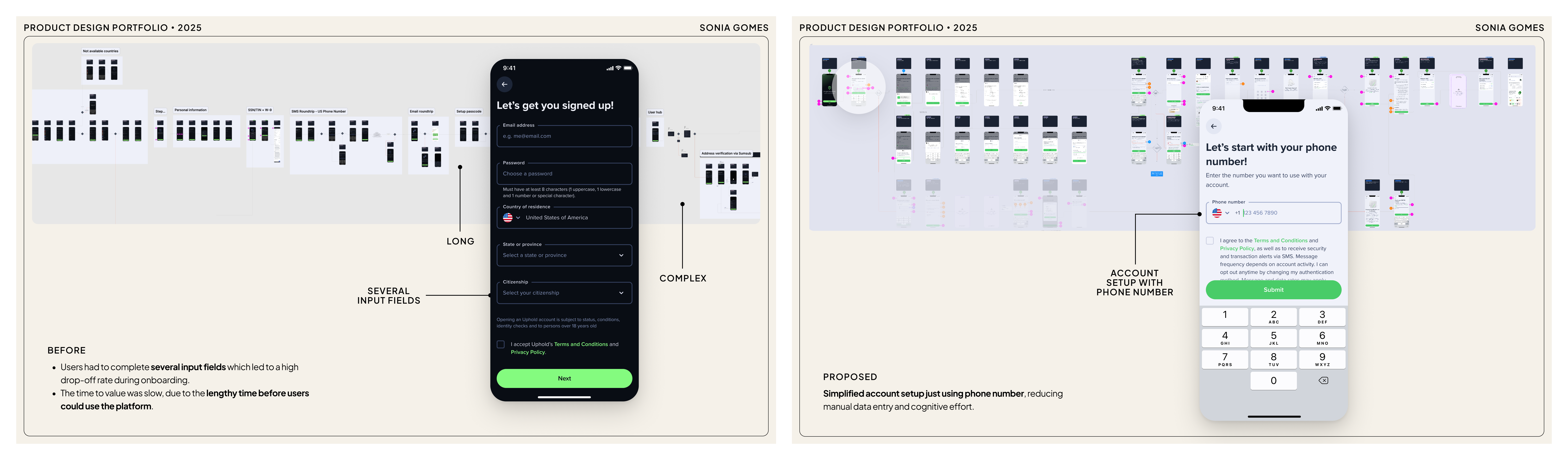
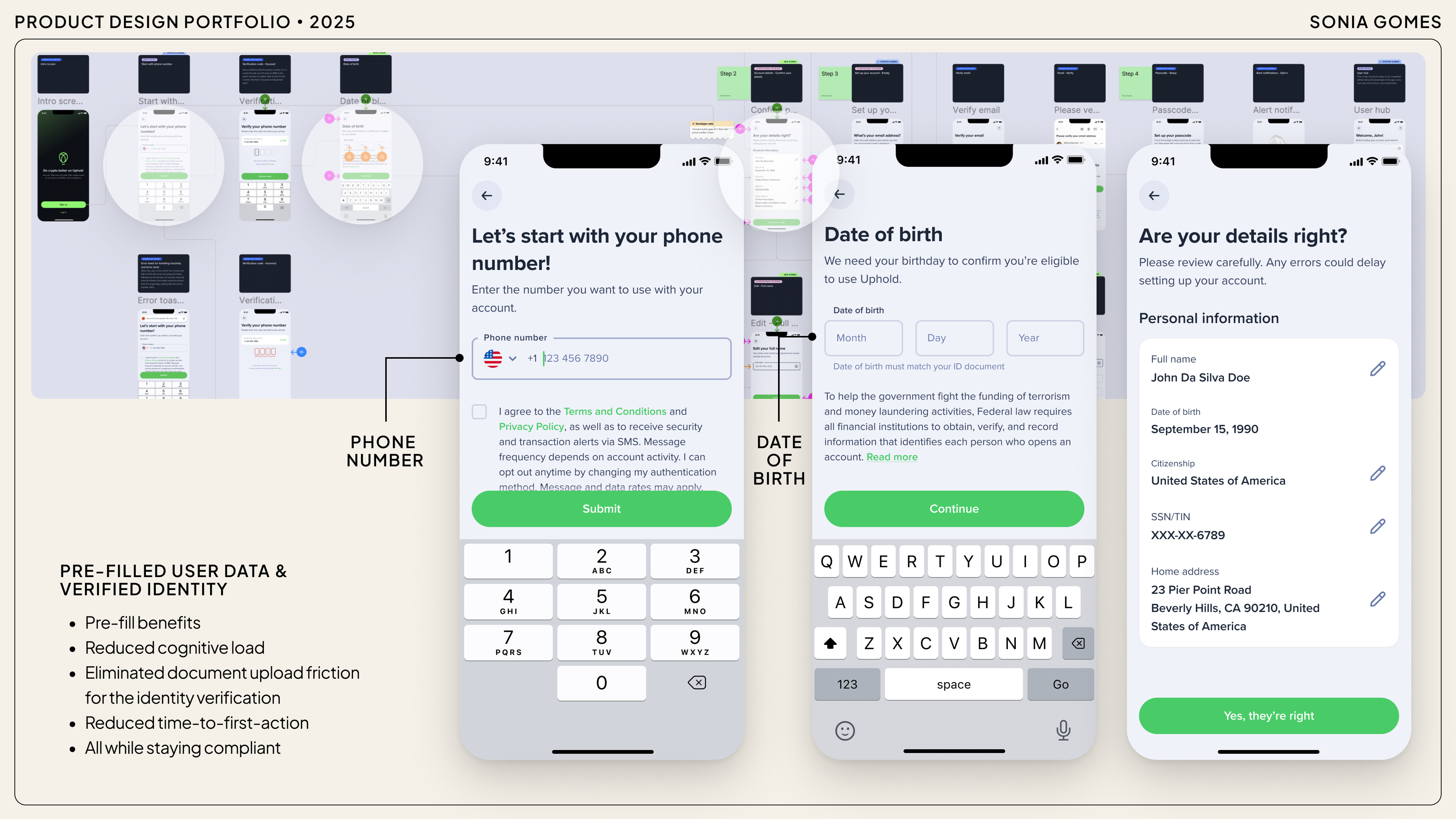
Funnel data pointed to the 11-step form as the core problem. The first redesign used Plaid Layer to auto-populate identity data and link bank accounts during sign-up, compressing the flow from 11 steps to 6. Prototype testing showed 40% faster onboarding, and users called it "cleaner and easier to follow."
AFTER LAUNCH
UNEXPECTED FAILURE
Completion rate dropped. The Plaid module was the exit.
PHASE 2
After rolling out as a live experiment, overall completion went down. Funnel analysis revealed a 40% abandonment at the "Link Bank with Plaid" step. The problem wasn't the form, it was context-switching. Pushing users into an external banking flow mid-sign-up created jarring friction and eroded trust at the worst possible moment.
NEW DIRECTION
Pivot to Prove: solve identity, not payments
An A/B test confirmed that pre-filled personal data was valued, but forced bank-linking was the killer. By partnering with Prove (identity verification specialists), the new flow auto-populates identity data using just a phone number and date of birth, no document uploads, no selfies, no external redirects. The flow collapsed from 11 steps to 5, fully compliant.
RESULTS & IMPACT
From compliance-first
to user-first, with the numbers to show it
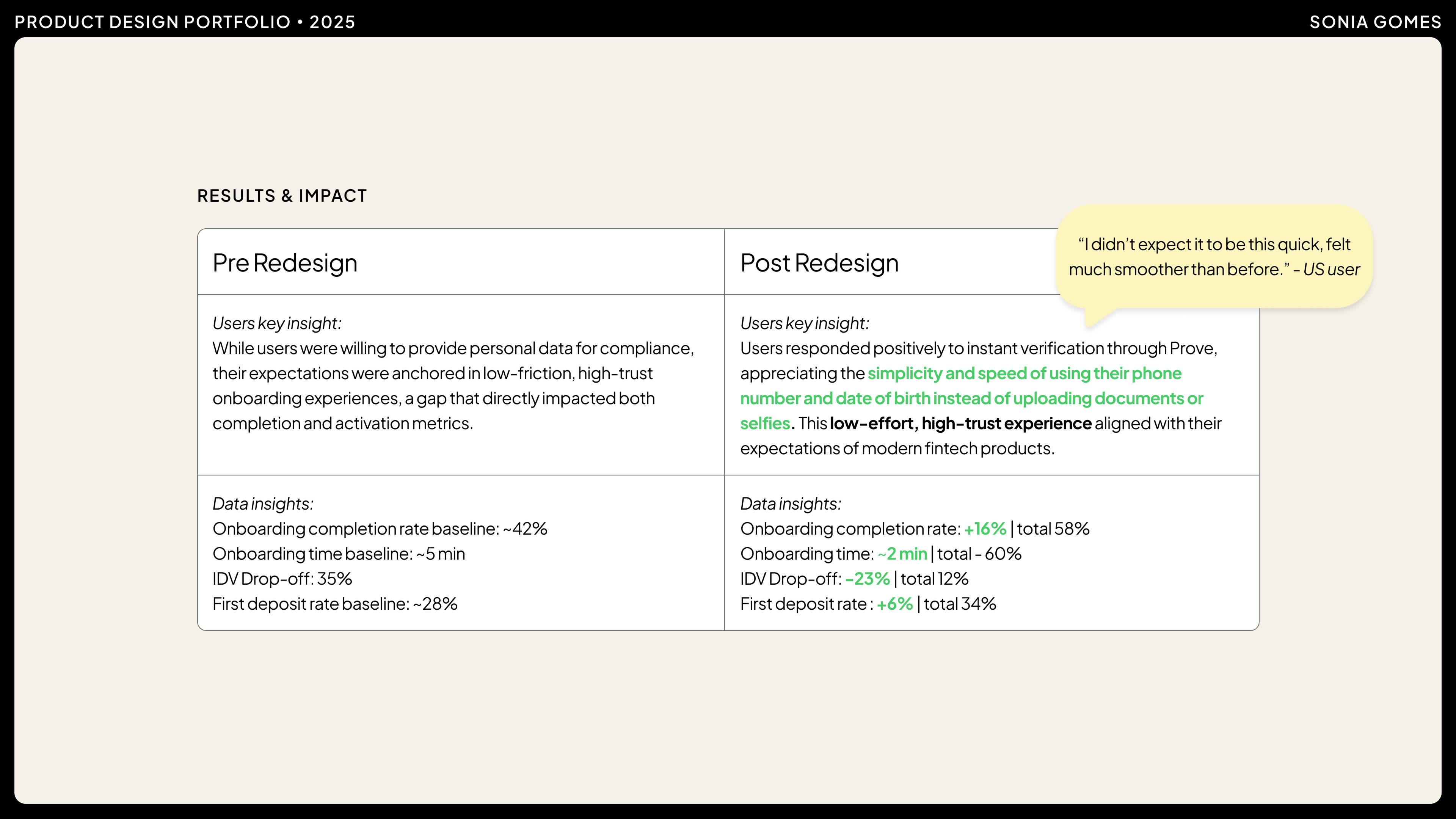
EFFICIENCY
COMPLETION
-60%
+16%
Onboarding time reduced from ~5 min to ~2 min. Step completion rate improved across the board.
Onboarding completion rate rose from 42% to 58%, the primary business KPI.
IDV DROP-OFF
ACTIVATION
-23%
+6%
Identity verification abandonment fell from 35% to 12%, the most stubborn point of friction.
First deposit rate increased from 28% to 34%, with CSAT/NPS up and support tickets down.
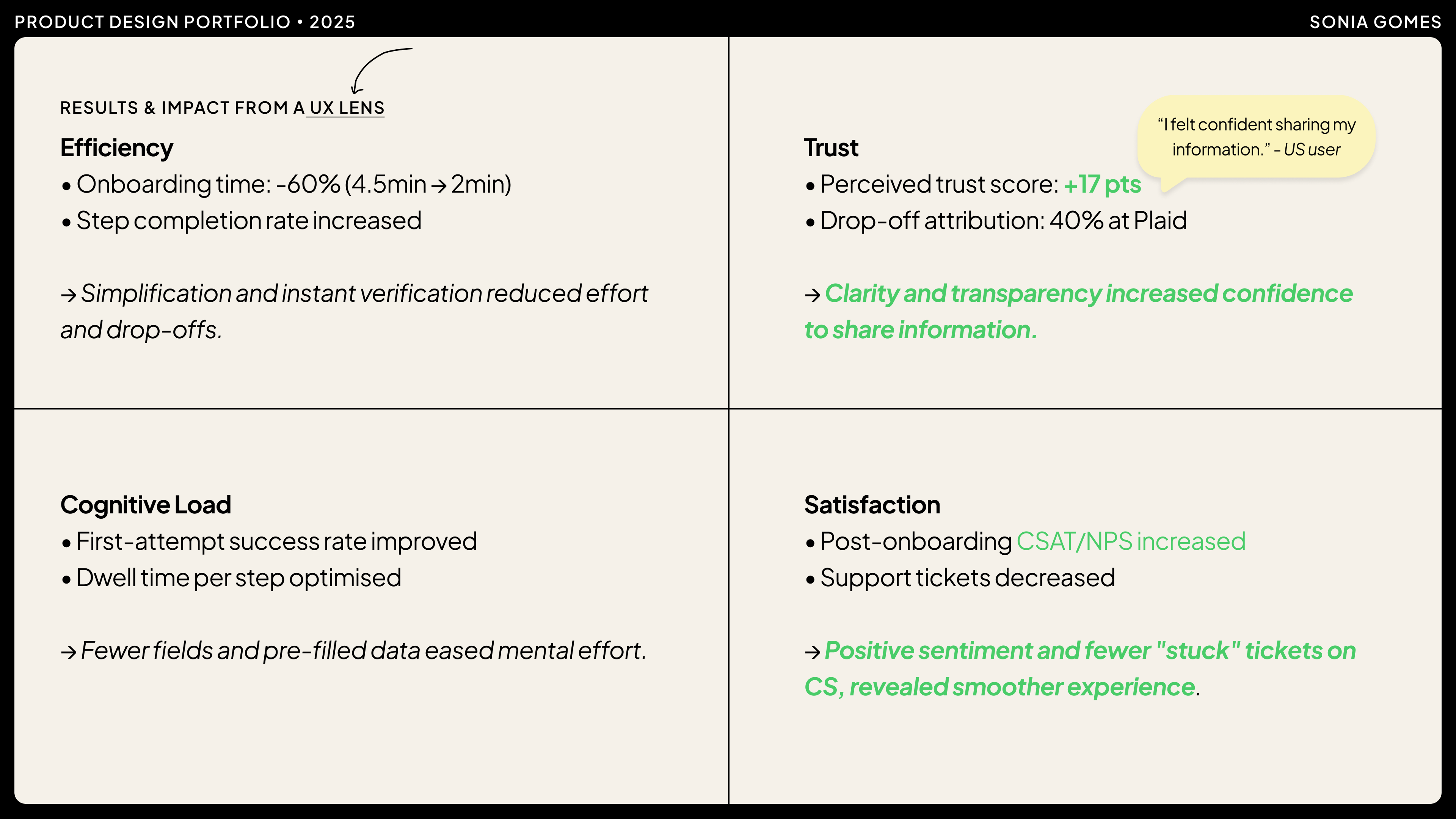
We didn't just track how many users completed onboarding — we tracked how it felt.
By measuring efficiency, trust, cognitive load, activation momentum, and satisfaction, we could see exactly where design decisions translated into genuine experience improvements, not just funnel gains.
REFLECTIONS
What this project
taught me about design leadership
01
Experimentation is essential, even when it fails
The Plaid experiment taught us that failure can reveal what truly matters, trust, not just speed. A false start that revealed a real insight.
02
Trust is a design outcome, not a checkbox
Clear copy and transparency during a sensitive sign-up flow transformed user hesitation into confidence. Clarity is a design lever.
03
Compliance and UX don't have to compete
Early collaboration with legal and compliance teams turned regulatory restrictions into moments of reassurance, not walls.
04
Systems and relationships drive scalable design
A structured product development workflow, Jira visibility, weekly stakeholder syncs, agile ceremonies, improved delivery predictability and team alignment.
MY ROLE
End-to-end ownership
across design, leadership & operations
End-to-end design ownership · UX research & synthesis · A/B testing strategy · Vendor evaluation · Cross-functional alignment · Design leadership · Mentoring & hiring · Workflow facilitation
TEAM
2 PMs · 2 Designers · 8 Engineers
+ Compliance, Legal, Customer Support
DURATION
6 months · 2025
PLATFORM
Mobile · iOS & Android · B2C
DOMAIN
Fintech · Crypto · KYC/AML regulated
WANT THE FULL STORY?
See the research, wireframes,
decisions, and the pivot in detail.
SELECTED WORKS

UpholdProduct Design
OutsystemsDesign Leadership, Design Operations, Design Systems & Research Ops

ProzisDesign Leadership, Product Design, Design Systems

The Scene ClubAndroid App
BlossomMobile App & Landing Page

Betfair ExchangeWeb App
PaybaseWebsite & Branding

EY MobilityWeb App